Automotive Industry Trends 2026: EVs, AI, Chinese Competition and the Fight for Scale
Published
The global automotive industry is entering a major transformation as electric vehicles, AI, autonomous driving, software-defined vehicles and Chinese automakers reshape the market. This guide examines the biggest opportunities, risks and changes facing the auto industry in 2026.
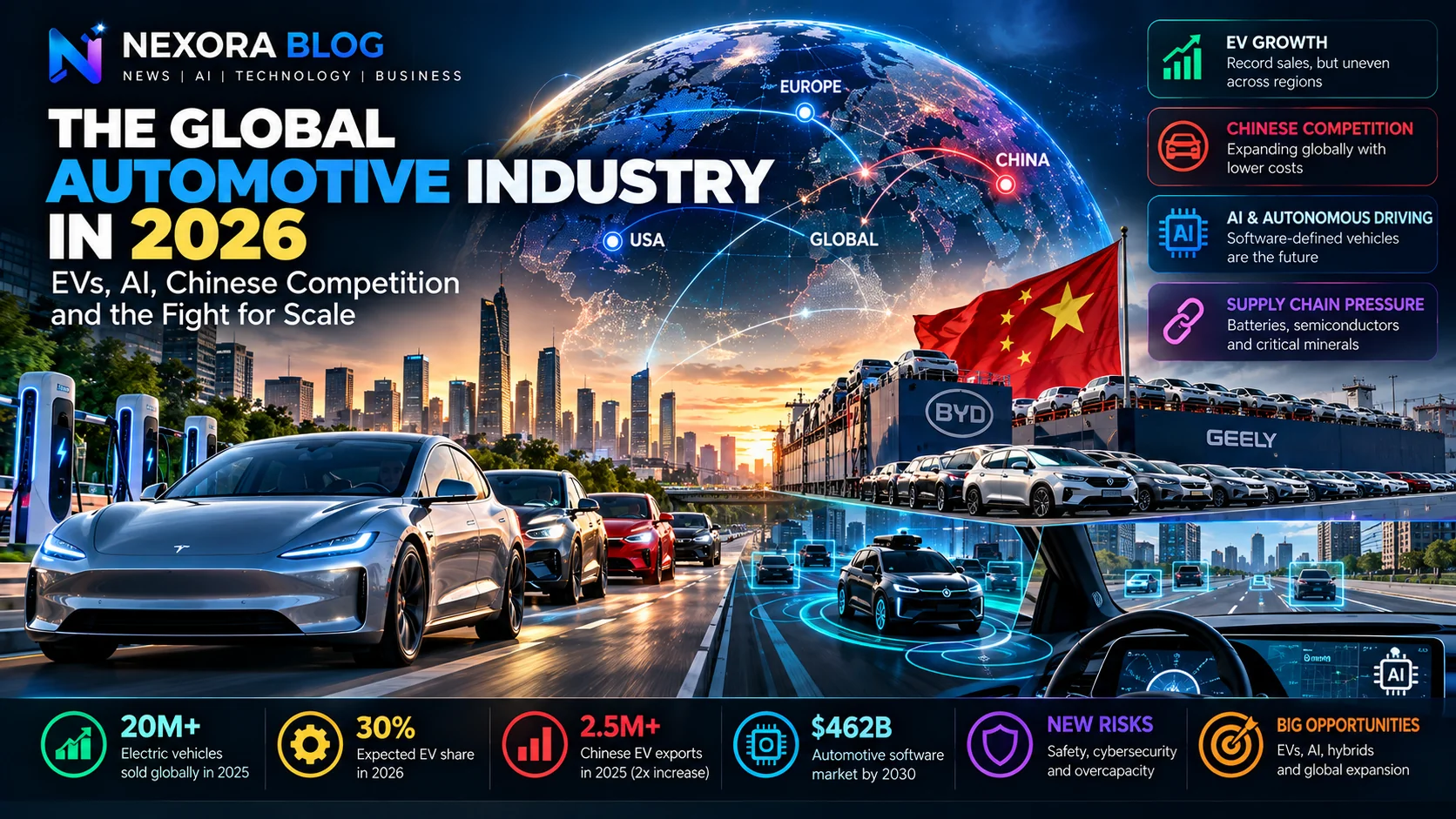
The Global Automotive Industry Is Being Rewritten: EVs, AI, China and the Fight for Scale
The global automotive industry is no longer changing in just one direction.
Electric vehicles are growing, but not at the same speed everywhere. Hybrid vehicles are gaining renewed attention in some markets. Chinese automakers are expanding beyond their home market. Cars are becoming increasingly software-defined. Autonomous-driving systems are moving closer to commercial deployment, while regulators are paying greater attention to safety. At the same time, traditional manufacturers are cutting costs, simplifying product lines and restructuring factories to survive a more competitive global market.
This is not simply a transition from petrol cars to electric cars.
It is a transformation of how cars are designed, manufactured, sold, updated, financed and competed against.
Reuters' current Autos & Transportation coverage shows the industry dealing simultaneously with EV demand shifts, Chinese competition, restructuring, scale, autonomous driving, software, tariffs and supply-chain pressures.
2026 Is a Record Year for Electric Vehicles — But the Story Is Uneven
The global EV market has continued to expand.
The International Energy Agency says electric car sales exceeded 20 million vehicles in 2025, up about 20% from the previous year, meaning approximately one in four new cars sold globally was electric. China remained the largest market, with more than 13 million electric cars sold and an EV share of almost 55% of new car sales. Europe also accelerated, with sales rising around 30% to more than 4 million vehicles in 2025.
But 2026 has shown that EV adoption is highly sensitive to market conditions.
Reuters reported that global EV sales reached 1.83 million units in August 2026, up 2% year over year. Europe grew 36% to about 380,000 vehicles, while China fell 11% and North America dropped 33%. Sales in the rest of the world jumped 97%.
That divergence is important.
There is no single global EV market behaving in one uniform way. Government incentives, fuel prices, charging infrastructure, vehicle prices, product availability and local regulations can all change the pace of adoption.
The IEA expects global electric-car sales to reach around 23 million in 2026, representing close to 30% of total car sales, although the actual outcome remains sensitive to economic conditions and policy changes.
The EV Race Is Becoming a Price and Scale Race
Early EV competition was heavily focused on batteries, range and technology.
The next stage is increasingly about cost, manufacturing scale and speed.
China is central to that shift.
The IEA says China produced nearly 22 million electric cars globally in 2025 as part of a world output approaching that level, with Chinese manufacturers accounting for a dominant share of EV manufacturing and global EV exports. Chinese electric-car exports more than doubled in 2025 to more than 2.5 million vehicles.
Reuters has repeatedly documented the resulting pressure on established manufacturers.
Honda, for example, is pursuing more than $9 billion in cost savings by 2030 and has asked suppliers for substantial cost reductions as it responds to competition from Chinese automakers. Reuters reported that Honda is also shifting greater emphasis toward gasoline-electric hybrids after major EV-related losses.
This tells us something important about the automotive industry.
Innovation alone is not enough.
An automaker can have excellent technology and still struggle if its production costs, supplier base, software development or manufacturing scale are not competitive.
Chinese Automakers Are Changing the Competitive Map
Chinese automakers are no longer competing only inside China.
They are increasingly selling electric and hybrid vehicles across Europe, Southeast Asia, Latin America, the Middle East and other markets.
Reuters reported that Guangzhou Automobile Group is planning as many as 12 electric and hybrid models for France by 2030 and is exploring European production capacity.
Another Reuters report highlighted concerns from BMW's CEO about low-cost Chinese vehicles entering Europe, while BMW has opposed additional tariffs and called for market-based solutions and political dialogue instead.
The important point is not simply that Chinese companies are selling cheaper cars.
They are combining manufacturing scale with batteries, software, fast product development and increasingly sophisticated technology.
That creates pressure on established manufacturers to improve simultaneously across multiple areas instead of competing only on traditional engineering.
Scale May Become One of the Biggest Winners
Reuters' new Auto File analysis identified scale as a central issue for the industry's future.
Automakers need enough volume to spread development, manufacturing and supplier costs across sufficient numbers of vehicles.
Too little scale can make a vehicle program expensive.
Too many models can increase complexity.
Too much production capacity can leave expensive factories underused.
Reuters reported that Volkswagen's restructuring plan includes a further 50,000 job cuts, more than 500,000 units of excess European production capacity, and a goal of reducing its model range by about 50% while cutting complexity by about 75% by 2035.
The move illustrates how manufacturing economics are changing.
The industry is not simply trying to build more cars.
It is trying to build the right cars at the right cost and in enough volume.
What Can Go Wrong?
The automotive transformation creates enormous opportunities, but it also creates several ways for companies to make costly mistakes.
Chasing EV volume without sustainable economics
Selling more EVs does not automatically create a profitable EV business.
Battery costs, price competition, charging expectations, warranty obligations, factory investment and software development all affect margins.
Honda's restructuring and Volkswagen's current pressure demonstrate how expensive an unsuccessful product or regional strategy can become.
Expanding too quickly
The industry's history contains repeated examples of companies spending heavily before reaching sufficient production scale.
Reuters noted the failures of several EV startups that raised billions but could not reach sustainable scale, highlighting the difference between raising capital and building a viable automotive business.