Data Center IPOs Face a New Test: Can AI Infrastructure Deliver Real Returns?
Published
AI is driving a data-center boom, but IPO investors are demanding clearer proof of power, customers, cash flow and sustainable returns.
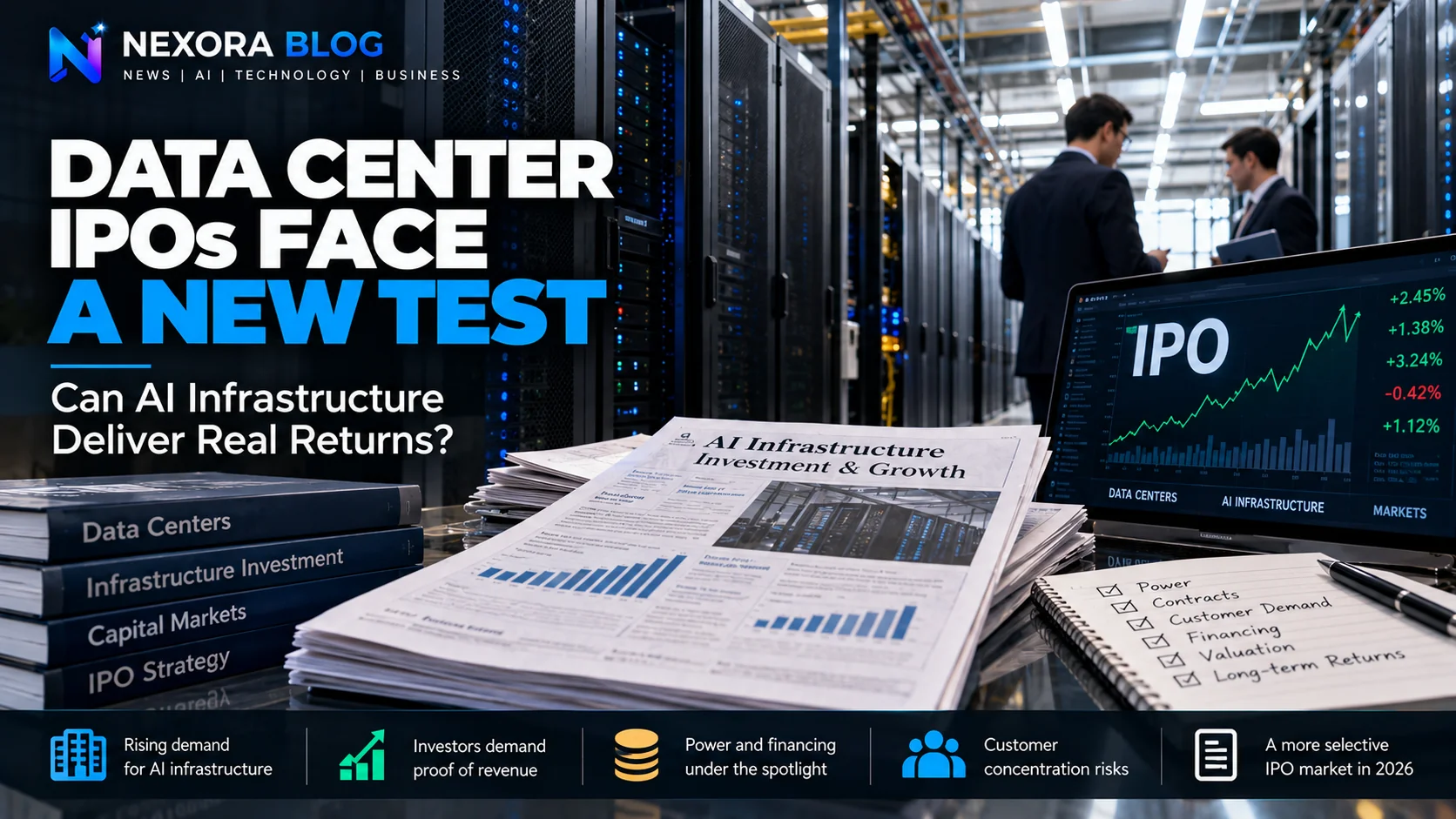
Key takeaways
- Data-center IPO interest remains strong, but investors are becoming more selective about AI infrastructure companies.
- Contracted revenue, secured power and operating capacity are increasingly important to public-market investors.
- Heavy reliance on a single AI customer can create valuation and financing risks.
Data Center IPOs Face a New Test: Can AI Infrastructure Deliver Real Returns?
The artificial intelligence boom has created one of the largest infrastructure investment cycles in modern technology.
AI models need enormous amounts of computing power, and that computing power requires data centers, electricity, cooling systems, networking equipment and specialized hardware.
For years, investors largely focused on the growth opportunity.
Now they are asking a different question:
Can the companies building the infrastructure turn that enormous demand into predictable, durable returns?
That question is becoming increasingly important as a new group of data-center operators prepares to enter the public markets.
Reuters reported on September 25 that data-center IPO hopefuls are facing greater investor scrutiny as higher interest rates, financing pressure and setbacks elsewhere in the AI infrastructure ecosystem make the IPO market less forgiving.
The Data-Center IPO Pipeline Is Growing
Interest in public listings has not disappeared.
Reuters reported that Singapore-based DayOne Data Centers was targeting a U.S. public filing in mid-October and potentially a November debut, although the company cautioned through sources that timing could change. DayOne develops and operates data centers for cloud and AI customers.
Reuters also reported that companies including Switch, Vantage Data Centers and CyrusOne were exploring or preparing potential IPOs. Switch had already filed confidentially, according to Reuters reporting.
That pipeline shows how strongly the AI boom has changed the economics of digital infrastructure.
But the public markets are no longer treating every data-center story equally.
Investors Want Proof, Not Just a Growth Story
The most important dividing line is increasingly the difference between planned capacity and contracted, usable capacity.
Reuters quoted Singapore-based research firm Shenton Research saying investors are increasingly distinguishing between demand that is already contracted and energized and projects that exist mainly in development plans.
That distinction matters.
Building a data center requires substantial investment before it produces revenue.
Land has to be secured.
Power has to be available.
Buildings must be constructed.
Cooling systems and networking infrastructure have to be installed.
Customers then need to take capacity.
A project can look enormous on paper while generating little actual cash flow if construction, grid connections or customer commitments fall behind schedule.
This is why operating facilities and contracted revenue can become more valuable to investors than simply announcing another large future campus.
DayOne Has Several Features Investors Are Looking For
Reuters highlighted DayOne's geographic diversification and its operating data centers as factors that distinguish it from some rivals.
The company closed a $4.5 billion Series C financing round in June 2026. DayOne said the funding would support expansion across Asia-Pacific and Europe, and the company reported more than 1.5 gigawatts of total capacity bookings.
Reuters later reported that DayOne could seek as much as $5 billion in an IPO at a valuation of around $20 billion, although the details remained subject to market conditions.
The important point is not the valuation itself.
It is what the numbers represent: capital already raised, operating infrastructure, geographic diversification and contracted capacity.
Those factors can give investors more information about the underlying business than a company whose facilities remain largely on paper.
SB Energy Shows the Other Side of the Story
The same week provided a contrasting example.
Reuters reported that SoftBank-backed SB Energy postponed plans to formally market its IPO, while addressing additional questions from the U.S. Securities and Exchange Commission. Reuters also reported investor concerns around its expected valuation and its dependence on OpenAI as a major customer.
Sources cited by Reuters said discussions had centered around a valuation of roughly $60 billion.
That illustrates one of the biggest risks in the data-center business:
Customer concentration.
If a significant proportion of future revenue depends on one major AI customer, investors have to evaluate not only the strength of the data center itself, but also the financial strength, plans and long-term demand of that customer.
A data center can be physically excellent and still carry meaningful commercial risk if its revenue depends too heavily on one client.
AI Infrastructure Is Extremely Capital Intensive
The economics of the AI buildout help explain why investors are paying so much attention to financing.
Reuters reported that AI-related capital spending by the six largest U.S. technology companies is projected by Moody's to reach around $1 trillion in 2027.
Data-center developers must finance infrastructure that can cost billions before those facilities begin producing their full economic return.
That makes interest rates important.
When financing becomes more expensive, the required return on a project also rises.
A development that looked economically attractive when money was cheap can look very different when borrowing costs increase.
This is why the data-center IPO market is increasingly connected to the broader credit market.
Debt Is Not Automatically Bad — But Revenue Visibility Matters
Debt can accelerate infrastructure expansion.
It can allow a company to build facilities faster than equity financing alone would permit.
But the underlying revenue has to support that debt.
Reuters quoted CBRE's Neil Bear-Hetherington saying that developers relying on debt need contracted revenue from creditworthy customers because the facilities require large upfront investments in high-density racks and liquid-cooling systems.
The basic equation is straightforward:
Large capital expenditure + debt = need for dependable long-term cash flow.
If customer contracts are weak, short-term or highly concentrated, the financing structure becomes harder to defend.
Power Is Becoming the Real Constraint
Compute gets most of the attention in AI, but power may be the more fundamental physical constraint.
A data center cannot operate simply because the building is finished.
It needs reliable electricity at enormous scale.
The International Energy Agency estimates that global electricity consumption from data centers could more than double to around 945 TWh by 2030, with AI identified as the most important driver of that growth.
The IEA also says the electricity system has longer development lead times than data-center projects themselves.
That creates a potential mismatch.
A company can plan a facility relatively quickly, but grid infrastructure, generation capacity and transmission upgrades may take much longer.
For investors, that means a company's access to secured power can be almost as important as its land and customer contracts.