New Stroke Drug Shows Promise for Treatment Within 48 Hours
Published
A phase 3 trial found loberamisal improved 90-day functional recovery in selected ischemic-stroke patients treated within 48 hours.
Key takeaways
- Loberamisal is an investigational neuroprotective drug studied in acute ischemic stroke.
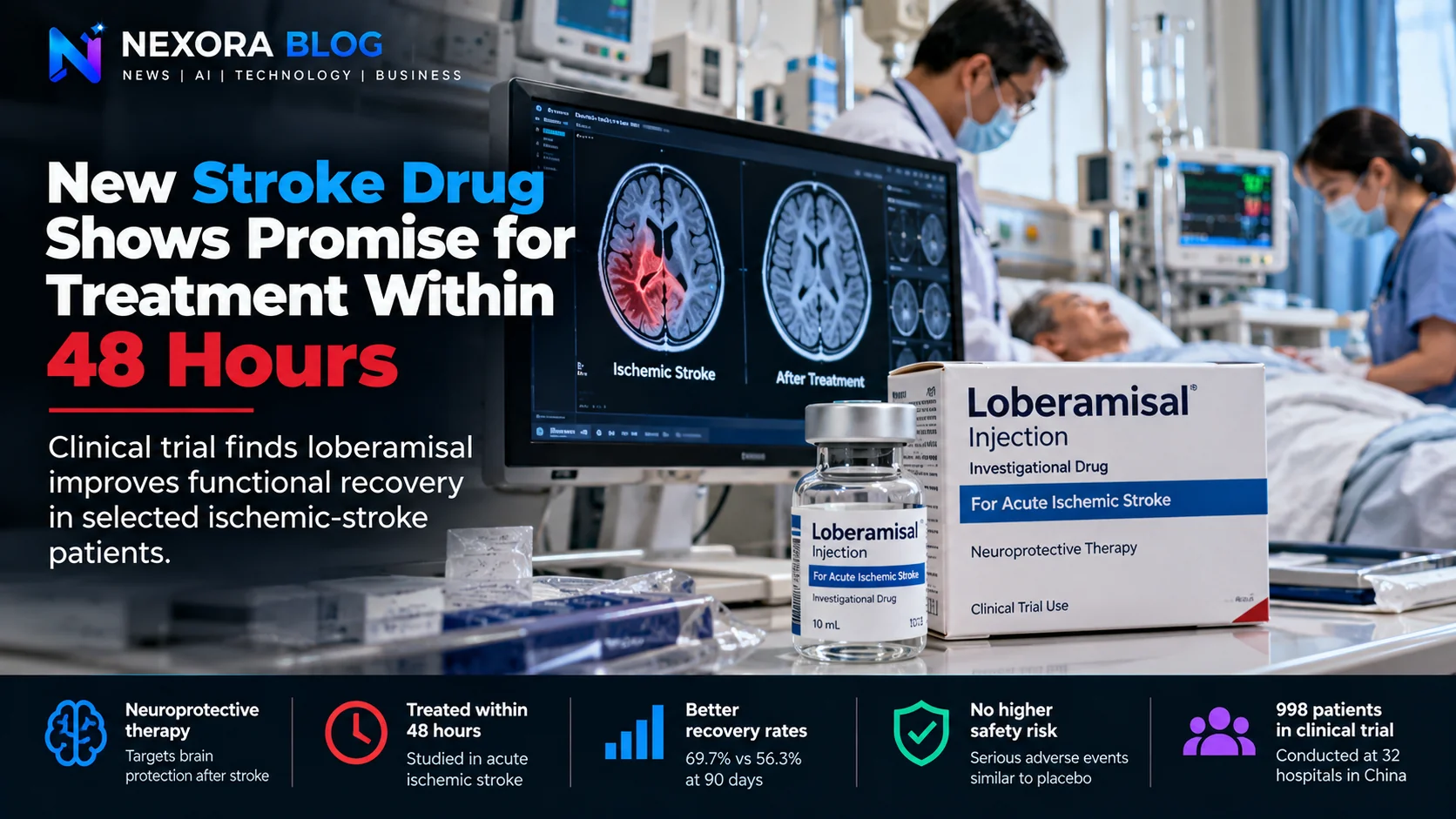
- In the phase 3 LAIS trial, 69.7% of patients receiving loberamisal achieved a full functional outcome at 90 days, compared with 56.3% receiving placebo.
- The trial included 998 patients at 32 hospitals in China and treated participants within 48 hours of stroke onset.
New Stroke Drug Shows Promise for Treatment Within 48 Hours
A new phase 3 clinical trial has produced promising results for patients with acute ischemic stroke, showing that the investigational drug loberamisal may improve functional recovery when administered within 48 hours of symptom onset.
The findings, published in JAMA on September 10, 2026, come from the LAIS randomized clinical trial, a multicenter, double-blind, placebo-controlled study involving 998 patients at 32 hospitals in China.
The result is important because most established acute-stroke interventions are strongly time dependent. But the new research does not mean people should wait before seeking emergency care. Instead, it points to a possible additional neuroprotective approach for selected patients who present later or remain disabled despite standard treatment.
What Is Loberamisal?
Loberamisal is a small-molecule drug designed to protect brain tissue after an ischemic stroke.
The compound targets two biological pathways: the postsynaptic density 95 (PSD-95) pathway and the α2-containing GABA-A receptor. Researchers are studying whether acting on these mechanisms can reduce the damage caused by ischemic injury and support recovery.
This approach is different from traditional clot-dissolving treatment.
Instead of primarily trying to reopen the blocked blood vessel, loberamisal is being investigated as a neuroprotective therapy that may help preserve or support damaged brain tissue.
What Did the Phase 3 Trial Find?
The LAIS trial randomized 998 adults with acute ischemic stroke. Participants were between 18 and 80 years old, had a baseline NIH Stroke Scale score of 7 to 20, had no meaningful pre-stroke disability, and presented within 48 hours of symptom onset.
Participants received either 40 mg of intravenous loberamisal or placebo once daily for 10 days, alongside standard stroke care.
The main outcome was functional recovery at 90 days, measured using the modified Rankin Scale.
The results showed a notable difference.
69.7% of patients in the loberamisal group achieved a modified Rankin Scale score of 0–1, compared with 56.3% in the placebo group.
That corresponds to a 13.28 percentage-point difference and a relative risk of 1.24.
In practical terms, the trial found that patients given loberamisal were more likely to reach the study's definition of a full functional outcome three months after their stroke.
What Does “48 Hours” Actually Mean?
This is where the headline can easily become misleading.
The study did not establish that all ischemic strokes can safely be treated for the first time two days after onset.
Instead, researchers enrolled a specific group of patients who presented within 48 hours and tested loberamisal alongside standard care.
The participants were relatively selected: they had moderate stroke severity, no significant disability before the stroke and other trial-specific eligibility requirements.
The JAMA authors explicitly say that further studies are needed to determine whether the findings extend to a broader patient population.
That limitation is essential when interpreting the results.
Why This Could Matter
The biggest potential significance is the concept of neuroprotection after the initial emergency window.
Stroke care has traditionally emphasized restoring blood flow as quickly as possible. Intravenous thrombolysis and mechanical thrombectomy can dramatically improve outcomes in appropriately selected patients, but eligibility depends on factors including timing, imaging, stroke type and the availability of specialized treatment.
A drug that could protect injured brain tissue for a longer period could potentially add another tool for patients who arrive later or remain at risk after reperfusion treatment.
Recent research has already been testing ways to extend treatment windows for selected patients. The 2026 American Heart Association/American Stroke Association guideline discusses evidence for extended-window intravenous thrombolysis in carefully selected populations, while also noting that these approaches differ depending on imaging, large-vessel occlusion and access to thrombectomy.
Loberamisal is therefore part of a broader scientific effort to move beyond the idea that every useful stroke intervention must occur within the earliest few hours.
Safety Results Were Also Important
The trial did not show a higher rate of serious adverse events or mortality with loberamisal.
Overall adverse events occurred in 87.8% of patients receiving loberamisal and 88.7% receiving placebo.
Serious adverse events occurred in 8.6% of the treatment group compared with 10.7% of the placebo group.
All-cause mortality was 1.2% with loberamisal versus 2.0% with placebo.
These results are encouraging, but they should not be interpreted as proof that the drug has no risks.
A larger body of evidence, broader patient populations and regulatory review are still necessary.
Who Was Actually Studied?
The trial's population matters as much as the headline result.
Participants were:
Adults aged 18 to 80 Diagnosed with acute ischemic stroke NIHSS score between 7 and 20 Without significant pre-stroke disability Treated within 48 hours
The trial was conducted at 32 hospitals in China.
That means the findings should not automatically be assumed to apply to every stroke patient, including people with very mild strokes, very severe strokes, intracerebral hemorrhage, major pre-existing disability or different clinical characteristics.
Is Loberamisal Already an Approved Stroke Drug?
The clinical evidence is new, but the medicine's regulatory process started earlier.
China Medical System Holdings announced in December 2025 that China's National Medical Products Administration had accepted the new drug application for its investigational loberamisal injection. A March 2026 company filing said the product remained under NDA review in China.
That means the JAMA trial results are an important part of the evidence base, but they are not the same as global regulatory approval.
Availability and approved use will depend on regulatory decisions and clinical guidance in individual countries.
What Could Change If the Findings Hold Up?
If future studies confirm the result in broader populations, loberamisal could become part of a new category of stroke treatment focused on protecting the brain rather than simply reopening the blocked vessel.
That could be especially relevant in healthcare systems where patients often arrive after the earliest treatment window.
It could also encourage further development of drugs that target the biological processes continuing after the initial stroke.
The broader scientific question is whether neuroprotection can become reliable enough to complement reperfusion therapies.
What Still Needs to Be Proven?
The trial is significant, but several questions remain.
First, researchers need to know whether the benefit applies outside the selected trial population.
Second, independent studies and longer-term evidence will help determine how reproducible the results are.
Third, regulators will need to evaluate the total evidence before deciding where and how the medicine can be used.
And fourth, clinicians will need to understand exactly where loberamisal fits alongside existing therapies rather than treating it as a replacement for emergency stroke care.
JAMA itself emphasizes the need for further studies before extending the findings to a broader population.
The Bigger Picture
The most important part of the loberamisal story may not be a simple claim that stroke treatment has suddenly gone from hours to two days.
The deeper development is that researchers are finding new ways to think about time after stroke.
The LAIS trial provides evidence that a neuroprotective drug given within 48 hours can improve the probability of full functional recovery in a selected group of ischemic-stroke patients.
That does not eliminate the urgency of stroke care.
It does, however, raise the possibility that the therapeutic window after brain injury may be more flexible for some neuroprotective strategies than previously thought.
For patients, the most important message remains simple: suspected stroke is an emergency and requires immediate medical evaluation.
For researchers, the question now is whether loberamisal's result can be reproduced, broadened and eventually translated into routine clinical practice.