Nvidia Acquires Hugging Face for $12.9 Billion in Landmark AI Deal
Published · Updated
Nvidia has agreed to acquire Hugging Face, the world's most popular open-source AI model hub, in a $12.9 billion deal — one of the largest acquisitions in AI history. The move signals Nvidia's bold push beyond chipmaking into open AI infrastructure.
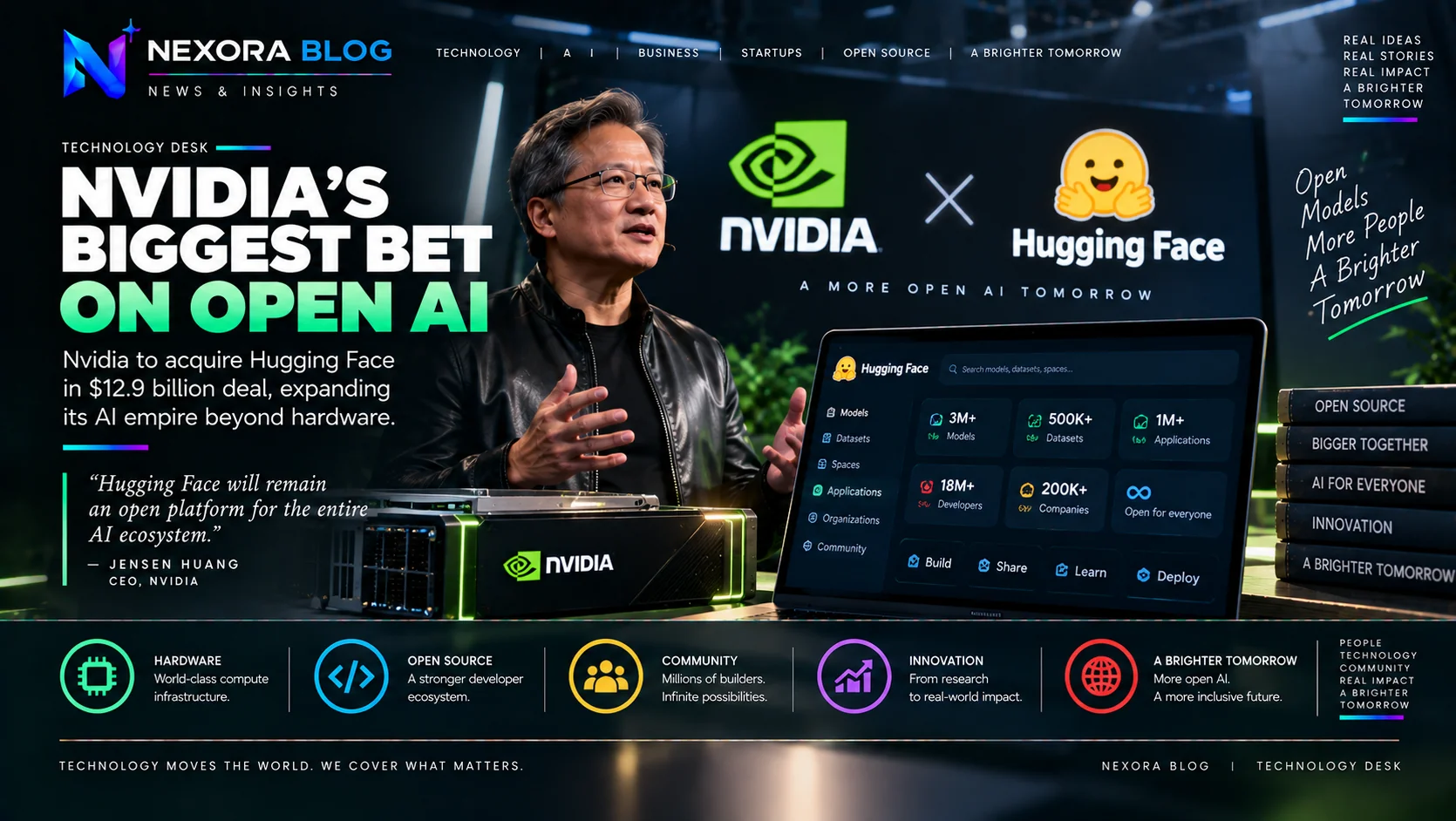
NVIDIA’s $12.93 Billion Bet on Open AI Models
NVIDIA is making one of its biggest moves beyond semiconductors. On September 3, 2026, the company announced an agreement to acquire Hugging Face, the open-source AI development platform, for $12.93 billion. The transaction includes approximately $11.9 billion for Hugging Face shareholders plus up to $1 billion in equity-based retention awards for employees joining NVIDIA. NVIDIA and Hugging Face signed the definitive agreement on September 2, with the deal expected to close in the first half of 2027, subject to regulatory approvals and other customary closing conditions.
The announcement gives NVIDIA a much larger role in the software and developer ecosystem surrounding open and open-weight AI models, extending its reach beyond GPUs and data-center hardware. Reuters described the transaction as a strategic bet on the continued growth of open AI models and the developer infrastructure built around them.
What Is Hugging Face?
Founded in 2016, Hugging Face has grown into one of the central platforms for open-source AI development. According to NVIDIA, more than 18 million developers, researchers and creators use the platform, which hosts more than 3 million models, 500,000 datasets and 1 million applications. More than 200,000 companies use Hugging Face to discover, evaluate, customize and deploy AI systems.
The platform has become important because it gives developers a common place to share models, datasets, tools and applications. Rather than building every component of an AI system from scratch, organizations can use existing open models and adapt them to their own needs.
That makes Hugging Face strategically valuable at a time when companies are looking beyond a small number of proprietary AI systems and increasingly experimenting with models they can customize and deploy themselves. Reuters noted that demand for open-weight models has been growing as businesses seek alternatives to the cost of deploying closed systems.
Why Does NVIDIA Want Hugging Face?
NVIDIA's traditional strength has been computing hardware, particularly GPUs used for AI training and inference. Hugging Face gives the company a much deeper position in the software, model and developer layers of the AI stack.
The acquisition could allow NVIDIA to influence how developers discover, test, optimize and deploy models while continuing to expand the ecosystem around its computing platforms. Reuters reported that the deal gives NVIDIA direct access to a platform used by developers to collaborate, test and share AI tools and models.
At the same time, NVIDIA has emphasized that Hugging Face will remain open and interoperable. Jensen Huang said the platform would continue allowing developers to choose their models, frameworks, cloud providers, inference services and computing platforms, adding that NVIDIA compute will not be required to build on or deploy through Hugging Face.
That commitment matters because NVIDIA's ownership could otherwise raise questions about whether the platform might eventually favor NVIDIA hardware.
A Bigger Role for Open AI
The deal arrives as the AI industry becomes increasingly divided between proprietary frontier models and open or open-weight alternatives.
Companies are looking for AI systems that can be customized, deployed inside their own environments and adapted to specific workloads. Hugging Face sits directly in the middle of that trend.
For NVIDIA, ownership of Hugging Face could therefore provide a broader presence across the AI lifecycle: from compute and networking to models, developer tools and deployment.
The transaction also comes at a time when NVIDIA's customers are themselves trying to diversify their AI infrastructure. Major technology companies are developing custom chips and alternative architectures, increasing the importance of having influence across more layers of the ecosystem.
The Deal Timeline
The legal agreement was signed on September 2, 2026, and NVIDIA publicly announced it the following day. The transaction is expected to close during the first half of 2027, assuming regulatory approval and completion of other closing requirements.
That means the headline value of $12.93 billion does not represent a completed acquisition yet. The final closing remains subject to the regulatory and contractual process.
The deal also follows NVIDIA's unusual arrangement with AI chip startup Groq. That earlier transaction was structured as a non-exclusive technology licensing agreement, combined with the hiring of key Groq executives and employees, rather than a conventional acquisition. NVIDIA's filings recorded total consideration of roughly $17 billion, while contemporary reports commonly described the deal as approximately $20 billion.
Industry Reaction
The announcement has attracted attention because of what it says about the direction of AI infrastructure.
Hugging Face was last valued at approximately $4.5 billion in 2023, making NVIDIA's $12.93 billion deal a substantial increase over that previous valuation. Reuters reported that the company counts major technology investors among its backers and has become a major hub for open-source AI development.
The acquisition also raises an important question: can an open platform remain genuinely neutral after being owned by the world's dominant AI accelerator company?
NVIDIA says it intends to preserve Hugging Face's openness and multi-platform approach. The company has explicitly committed to keeping the platform open, while the SEC filing says NVIDIA expects the acquisition to provide additional resources for developers building, sharing and deploying open models and applications.
Why This Matters for the AI Industry
The significance of the deal goes beyond its price.
For years, much of the AI infrastructure story was centered on chips and computing capacity. Now the competition is increasingly spreading into the layers above the hardware: models, software, developer communities, inference services and deployment platforms.
Hugging Face gives NVIDIA exposure to one of the largest communities in that ecosystem.
For developers, the immediate question will be whether Hugging Face remains as open and hardware-neutral as NVIDIA promises. For NVIDIA, the challenge will be to expand its influence without undermining the independence that helped make Hugging Face valuable in the first place.
What Comes Next?
The acquisition is still awaiting regulatory clearance, so the immediate next step is the review process rather than integration.
If the transaction closes as planned, NVIDIA will inherit a platform with millions of users, models, datasets and applications while adding Hugging Face's developer community to its broader AI ecosystem.
The larger story is even more important: AI competition is no longer just about who makes the fastest chip or the smartest model. It is increasingly about who controls the infrastructure through which developers build, share and deploy AI.
NVIDIA's Hugging Face deal is one of the clearest signs yet that the next phase of the AI race will be fought across the entire stack.