Pakistan IT Exports Hit $4.6 Billion But AI Is Already Cutting Entry-Level Jobs
Published
Pakistan's IT sector posted record $4.6 billion in exports for FY2025-26, up 21%. But the same year, entry-level developer jobs fell 25% and freelance listings dropped sharply as AI tools replaced routine work.
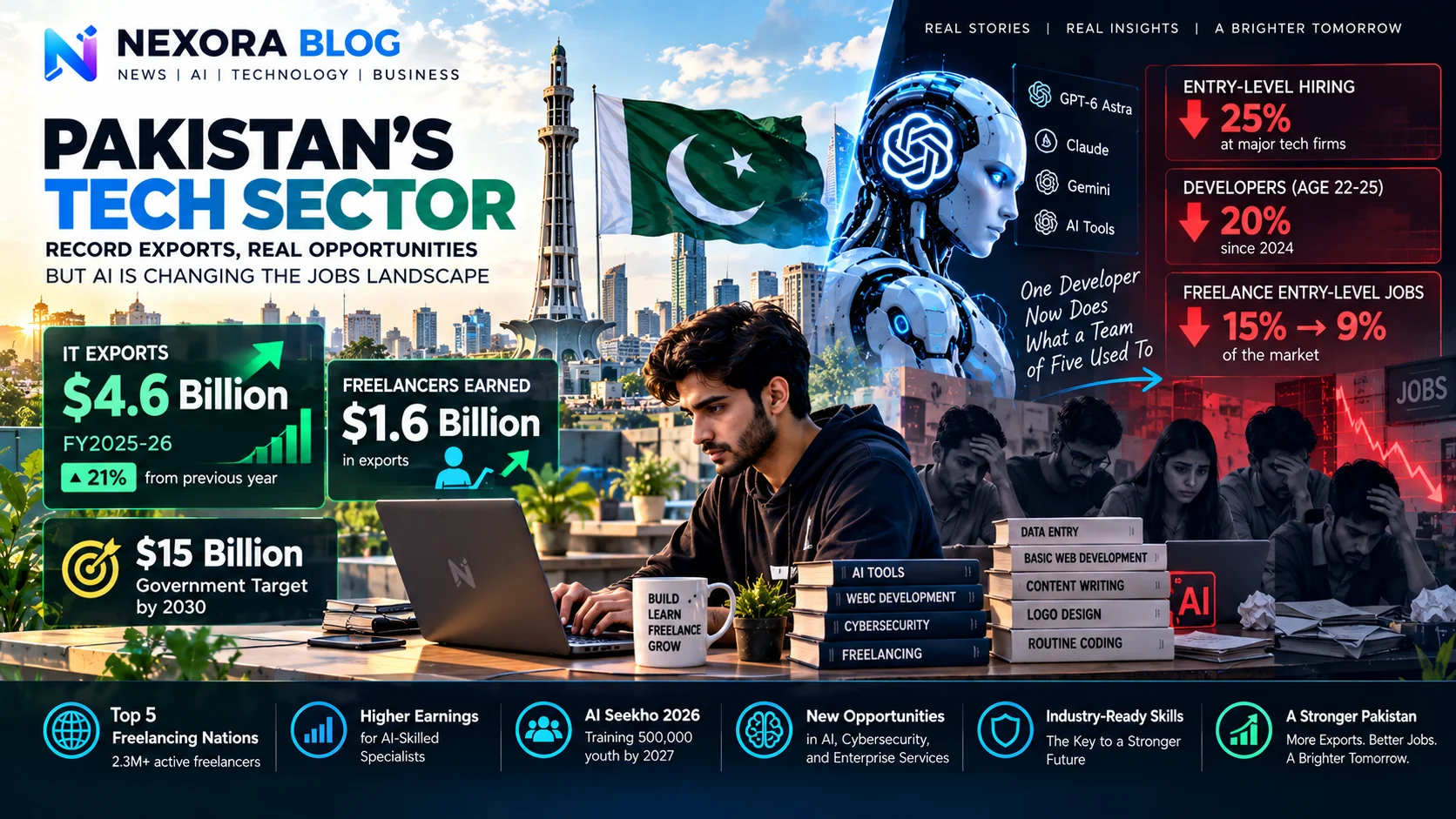
Pakistan's tech sector is celebrating a record year. IT and IT-enabled services exports reached $4.6 billion in FY2025-26, up 21% from the previous year. For the first time, freelancers alone crossed $1.6 billion in exports. The government's $15 billion target by 2030 looks ambitious but no longer impossible. But underneath these impressive numbers, something more complicated is happening.
The Same Year Jobs Started Disappearing
State Bank of Pakistan data confirms the $4.6 billion figure. But the Pakistan Software Houses Association, P@SHA, found that entry-level hiring at major tech firms fell by around 25% in the same year. Employment among developers aged 22 to 25 dropped nearly 20% since 2024. Freelance entry-level listings, once around 15% of the market, have fallen below 9%.
The reason is not that the industry is shrinking. It is that AI tools are doing the work that junior employees and basic freelancers used to do. A single developer with GPT-6 Astra or Claude Fable can now do what previously required a team of five. Clients who once hired five freelancers are now hiring one who uses AI. The work still exists. The jobs for humans doing it are disappearing.
Who Is Being Hurt
The freelancers and graduates hit hardest are those in what researchers call commodity categories: data entry, basic web development, simple content writing, logo design, and routine coding tasks. These are exactly the skills that millions of Pakistani youth have been trained in through crash courses and government programs. Pakistan is one of the world's top five freelancing nations, with over 2.3 million active freelancers. That pool of talent built a multi-billion dollar sector largely through individual effort. Now AI is automating the foundation that pool stands on.
Who Is Thriving
The picture is not entirely dark. Freelancers who have moved into AI-assisted services, cybersecurity, enterprise software, and high-value consulting are earning more than ever. The Express Tribune reports that average earnings per task for specialist freelancers are rising even as the total number of freelancers earning from entry-level work is shrinking. The ceiling is rising even as the floor collapses, as one analyst put it.
What the Government Is Doing
The Ministry of IT and Telecommunication has launched AI Seekho 2026, a nationwide upskilling program in partnership with Google for Developers and Telenor Pakistan. The target is to train 500,000 young Pakistanis by 2027 in AI-assisted tools, vibe coding, and app development. The goal is to help Pakistan's workforce move up the value chain before the disruption becomes a crisis.
Federal IT Minister Shaza Fatima Khawaja has acknowledged the challenge. Speaking at a LUMS forum, she said that Pakistan has the jobs and the opportunities but lacks sufficiently skilled, industry-ready talent to fill them.
The Bottom Line
Pakistan's IT exports are booming. That is real and worth celebrating. But the boom is hiding a structural shift that will hurt millions of young people if the country does not respond quickly. The question is not whether Pakistan can reach $15 billion in IT exports. The question is whether Pakistan's workers will still have a place in that number when AI keeps getting better.