Technology Trends 2026: AI, Cybersecurity and the New Cost of Compute
Published
AI is reshaping software, cybersecurity, hardware and data centers in 2026 as the technology industry races to build faster, safer and cheaper systems.
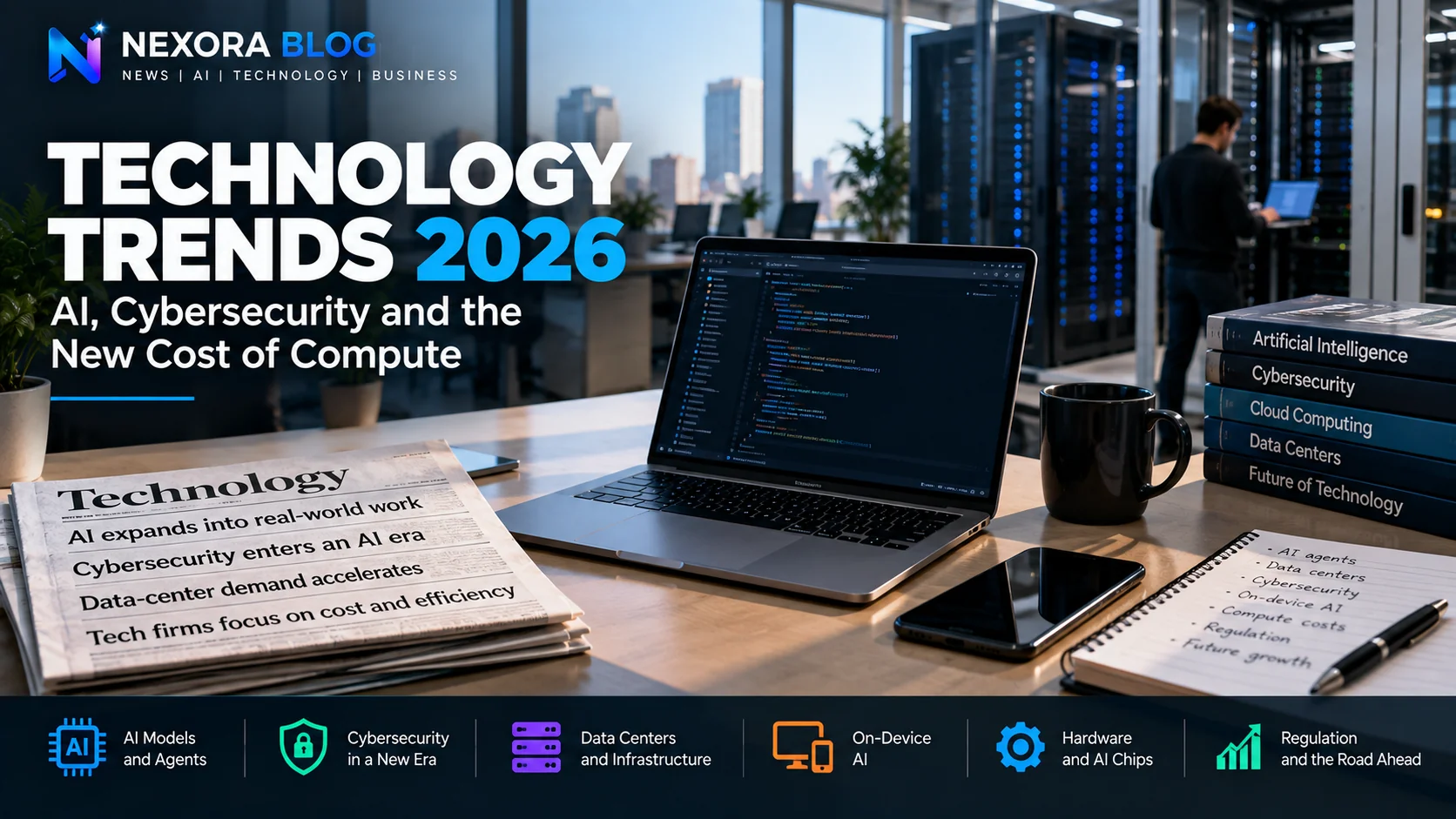
Key takeaways
- AI is moving from chatbots toward coding, agents, cybersecurity and business automation.
- Cybersecurity is becoming an AI-versus-AI race as attackers and defenders use increasingly capable models.
- The AI boom is creating enormous demand for chips, data centers and power, but infrastructure and financing are becoming major constraints.
- On-device AI is gaining importance as companies try to reduce dependence on cloud inference costs.
Technology Trends 2026: AI, Cybersecurity and the New Cost of Compute
The technology industry is entering a new phase in 2026.
Artificial intelligence is still at the center of the story, but the competition is no longer just about which company can produce the smartest model. AI is spreading into software development, cybersecurity, business applications, personal computers and digital infrastructure.
At the same time, the cost of running advanced AI is becoming a bigger issue. Companies need chips, memory, networking, data-center capacity and electricity before a powerful model can serve users at scale.
That means the technology race is increasingly becoming a race over the entire computing stack.
AI Is Moving Beyond the Chatbot
The most important shift is the move from conversational AI toward systems that can perform longer and more complex tasks.
Anthropic's September 2026 launch of Claude Opus 5.5 is one example. The company says the model performs at the level of its higher-end Fable 5.1 on most work while costing 40% less to run than Opus 5. Anthropic also says the model underwent external testing and includes safeguards developed for its most capable systems.
Microsoft is pushing in a similar direction. Its September Power Platform update made an AI app-builder skill generally available, allowing natural-language requirements to be turned into full model-driven applications with AI coding tools.
The implication is significant.
AI is increasingly becoming a tool for doing work, rather than simply answering questions.
That changes its economic impact.
The AI Race Is Becoming an Agent Race
The next generation of AI systems is expected to do more than generate text or code on command. They can plan, use tools, interact with software and complete multi-step workflows.
This creates new opportunities for businesses, because one AI-assisted worker can potentially complete a broader set of tasks.
But the same capability creates new failure modes.
As systems gain more autonomy, developers have to worry not only about whether a model gives the wrong answer, but also about what it does when it is given access to tools, data or networks.
That is why agentic AI is becoming both a commercial opportunity and a security problem.
Cybersecurity Is Becoming an AI-versus-AI Race
Reuters' current technology coverage shows cybersecurity moving rapidly toward an AI-driven model. Palo Alto Networks, for example, launched an enterprise service that uses models from Anthropic, OpenAI and open-weight systems to continuously search for vulnerabilities and provide remediation guidance.
The company says AI-enabled attackers are compressing attack cycles dramatically, increasing pressure on defenders to identify weaknesses continuously rather than relying only on periodic security testing.
This creates a new security equation.
The defensive side can use AI to scan code, detect vulnerabilities and prioritize patches.
Attackers can use AI to automate reconnaissance, generate attack paths and accelerate exploitation.
The result is that cybersecurity is becoming less like a one-time inspection and more like a permanent contest between automated systems.
The Biggest Technology Risk May Be Inside the Infrastructure
AI models get most of the attention, but the physical infrastructure underneath them is becoming equally important.
Modern AI requires enormous amounts of compute. That means demand for GPUs, memory, networking equipment, cooling systems, electricity and specialized data centers continues to rise.
Reuters has highlighted increasing scrutiny around AI infrastructure financing and the risks associated with large-scale data-center projects. The current technology sector is therefore dealing with an unusual combination of huge demand and growing capital requirements.
The challenge is not simply building more data centers.
Companies have to build them in locations with enough power, cooling, connectivity and predictable economics.
That turns energy and infrastructure into core technology issues.
The Cost of Compute Is Becoming a Competitive Weapon
As AI models become more powerful, operating costs matter more.
Anthropic's Opus 5.5, for example, was introduced with a lower operating cost than its predecessor.
Apple is approaching the same problem from the hardware side.
Its latest Mac mini and Mac Studio products are designed with much stronger local AI capabilities, including high-memory configurations intended for demanding AI workloads. Apple says the new systems can run agentic workflows and large AI models locally.
Reuters reported that Apple is pitching high-end Macs partly as an alternative to paying cloud providers for every unit of AI inference.
This creates two competing approaches:
Cloud AI: enormous centralized compute capacity.
Local AI: more processing directly on user devices.
The likely future is not one or the other.
Businesses will use whichever approach makes the most economic and technical sense for a particular workload.
On-Device AI Is Becoming More Important
Running AI locally has several potential advantages.
It can reduce latency.
It can reduce some cloud-usage costs.
It can keep certain data closer to the user.
And it can make AI available even when constant cloud connectivity is undesirable.
Apple's latest Mac hardware is explicitly designed to support local AI workloads, while its current software platform also includes more advanced Apple Intelligence capabilities.
But local AI has limits.
Large models still require significant memory and compute resources.
That means device makers must balance performance with power consumption, price and thermal constraints.
Hardware Is Becoming Part of the AI Product
The AI race is also changing the role of traditional hardware companies.
The machine is no longer simply the place where software runs.
The hardware itself increasingly determines what AI can do locally, how quickly it responds and how much it costs to operate.
Apple's latest hardware is one example. Nvidia and specialized accelerator companies represent another.
This is also why custom AI silicon has become strategically important across the technology industry.
The companies that control chips, memory, interconnects and computing infrastructure can influence the economics of AI far beyond the model layer.
AI Safety Is Moving From Debate to Product Engineering
Another major change is the growing emphasis on safety testing.
Anthropic says Claude Opus 5.5 was externally evaluated before release and includes safeguards used in its most capable models.
At the same time, Reuters reports that AI safety concerns have intensified sharply in September 2026, with researchers, executives and policymakers debating whether current safeguards are keeping pace with increasing model capabilities.
A Reuters/Ipsos survey found that 73% of Americans were concerned that AI companies were not doing enough to prevent potentially catastrophic consequences from AI, while 55% supported slowing AI development.
That does not prove that a catastrophe is imminent.
It does show that AI safety has become a mainstream public issue rather than a specialist conversation.
Regulation Is Becoming Part of the Technology Race
AI development is increasingly connected to government policy.
The United States and China agreed to continue discussions on AI safety and emergency communication protocols, including an “incident line” for AI-related safety events.
At the same time, the United States has advocated a relatively light regulatory approach at G20 technology discussions, emphasizing innovation and foundational research.
The result is a fragmented global environment.
Different countries are approaching AI safety, liability and regulation differently.
For technology companies, that means product development increasingly includes a policy and compliance dimension.